
Adams County Criminal Docket Searches
Nebraska's case-information service runs on JUSTICE, the statewide trial-court system. It returns case summaries, party lists, and offense details. Financial lines, registers of actions, and many public document images come through as well. For an Adams County criminal docket search, start with the right court. Add a full party name or a known case number. The public one-time search makes you check a terms box first. You can narrow a party-name search with a birth date, case type, or case year.
Keep two limits in mind. A one-time JUSTICE search caps results at 30 cases. It keeps them viewable for three calendar days. The service charges $17 per search, even one that returns nothing. Overnight updates lag. A fresh Adams County filing may not show up yet, and an empty result settles nothing. Save the case number and court name from any hit before you request a record.
- Decide whether the known matter is likely County Court, District Court, or an appeal.
- Use the party name first, then add year or case-type filters only when needed.
- Open the matching case and read the register of actions in date order.
- Compare the entry type, hearing status, charge, and disposition before drawing a conclusion.
- Ask the holding clerk for a specific copy or certification when an online result is not enough.
Note: A witness does not count as a searchable party. Search an Adams County criminal docket by a named party or case number instead.
Adams County Criminal Court Path
Which court keeps the file matters. Adams County Court handles misdemeanors, felony arraignments, and preliminary hearings, while Adams District Court takes felony cases past the preliminary stage. So one felony can leave a preliminary-hearing record in County Court and later show up as a District Court case. Nebraska's JUSTICE FAQ adds that only District Court can impose a sentence greater than one year.
That split makes court identification part of the docket search itself. A misdemeanor or traffic-related criminal matter usually stays in County Court, but a felony search should cover both Adams County courts when you are unsure. Appeals are separate too. Nebraska uses SCCALES for appellate case information, not the county and district JUSTICE search.
| Likely Adams County record | First court to check | Why the path matters |
|---|---|---|
| Misdemeanor | County Court | The local court identifies misdemeanors as County Court work. |
| Felony arraignment or preliminary hearing | County Court | The later felony record can move to District Court. |
| Felony trial or sentencing | District Court | District Court holds the felony trial-stage file. |
A source image from the Nebraska County Court rules accompanies this distinction.
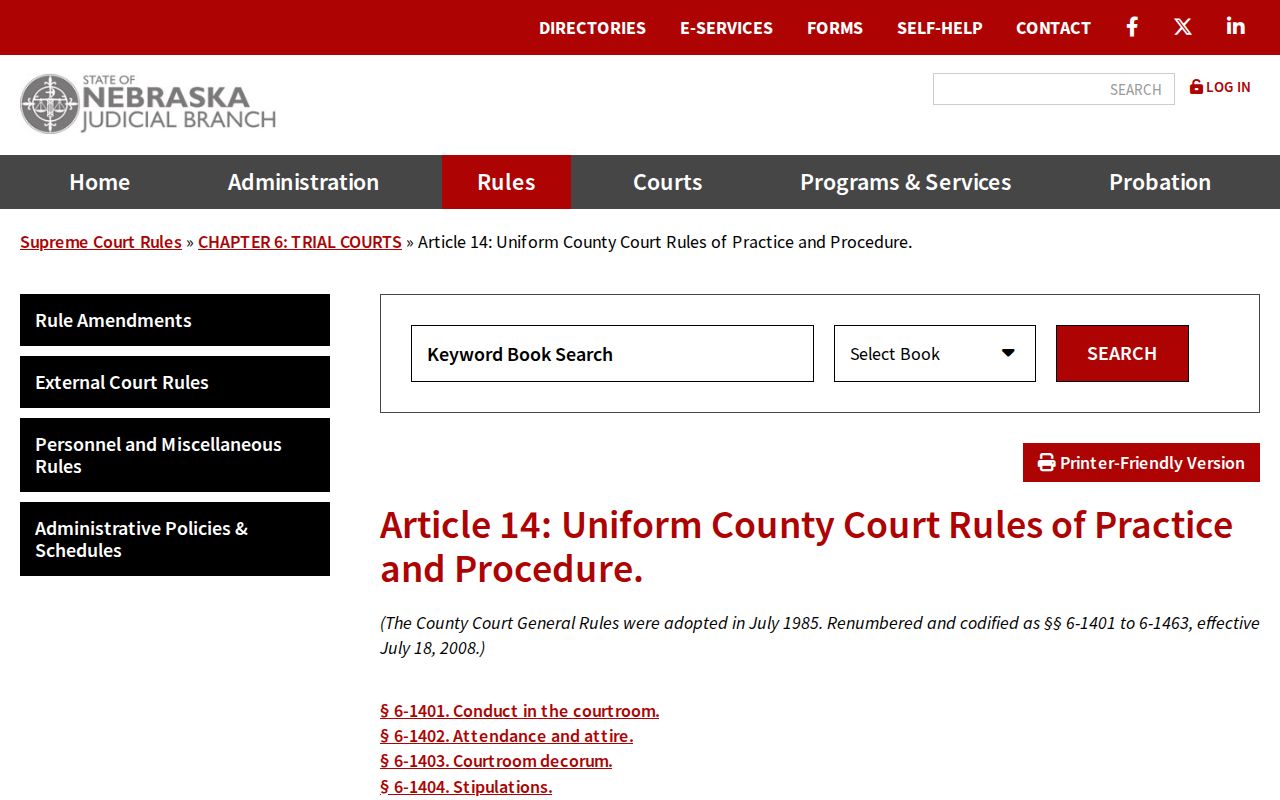
Statewide rules give the practice context, and the Adams County court pages tell you which local office holds the starting record.
Criminal Dockets: What They Show
Nebraska calls the register of actions the official court record, arranged as a chronological summary. In an Adams County criminal case you can read it next to party information, offense or count descriptions, settings, financial entries, the disposition, and any nonconfidential images. A charge field alone is not a finding of guilt. A financial line might be an assessment, payment, balance, restitution, or another cost.
| Case ID | An identifier whose structure captures case type, year, and sequence; record the exact value shown rather than creating a format. |
|---|---|
| Case type and court | Shows whether the Adams County matter is in County Court or District Court and helps separate stages. |
| Charge or count | Describes an alleged offense or amended count. It is not the same as a conviction. |
| Register entry | A dated action such as an arraignment, motion, continuance, hearing, order, plea, or dismissal. |
| Disposition | The recorded outcome or case status. Check later entries for a final order or sentence. |
Sometimes a public image is missing. The reason could be a restriction, an unscanned file, or slow timing in the electronic system. A missing image does not prove the underlying Adams County criminal court record does not exist.
Reading an Adams County Criminal Register
Read a register in order, from filing to finish. Begin with the charge entry, then follow the settings, motions, pleas, orders, and final action. "Disposition" means the outcome or current status. "Continuance" means a postponed proceeding. A preliminary hearing is an early probable-cause step in a felony case, not the trial.
- Arraignment
- A proceeding where the criminal charge is addressed under the applicable procedure.
- Register of actions
- The court’s chronological official summary of filings, hearings, orders, and other events.
- Disposition
- The recorded outcome or status of a charge or case, such as a dismissal, plea, or judgment.
- Sentencing
- The proceeding where the court imposes a sentence after a qualifying plea or finding.
Stick to the exact docket language. A dismissed count does not always end the whole case. A scheduled hearing proves nothing about what happened there. If a case is appealed, treat the local trial record and the SCCALES appellate record as two different files. The district-court records-maintenance rule lays out the official electronic, paper, and index context.
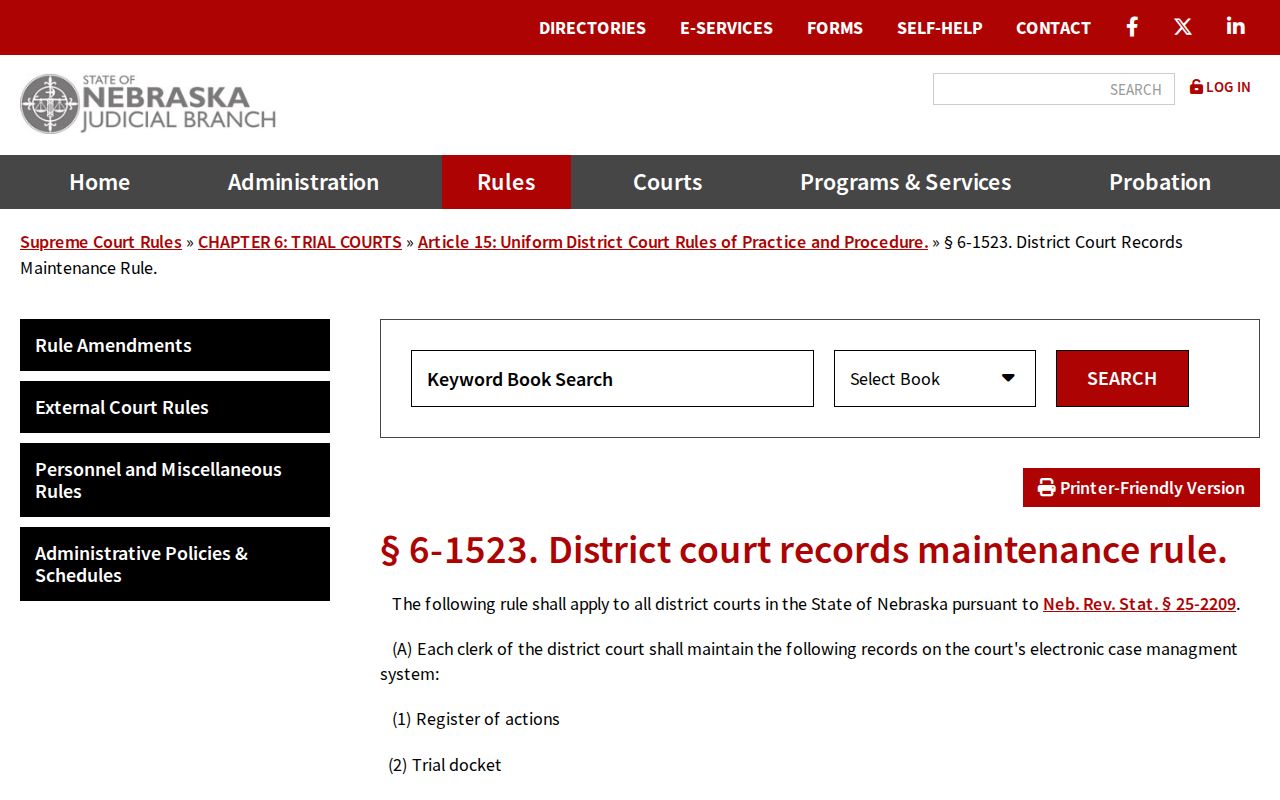
That rule explains why the register is only a summary, and why the clerk may still hold a paper or electronic file behind a docket line.
Criminal Case Stages on the Docket
An Adams County criminal docket can trace a case from charge through arraignment, pretrial settings, a plea or trial, disposition, and sentencing. Not every case hits every stage. A continuance can move any setting. Trust the procedural label over a guess based on the case caption alone.
Typical docket flow: Charge filed › Arraignment › Preliminary hearing or pretrial setting › Plea or trial › Disposition › Sentencing when applicable.
For a future County Court setting, the statewide calendar can help you locate the date. Adams District Court is excluded from the statewide district-court calendar list, so confirm any District Court setting with that clerk and the register of actions. The Adams County Court Schedule gathers both confirmation routes in one place.
Adams County Criminal Docket Workload
The FY2025 caseload reports size up the two Adams County criminal dockets. County Court reported 276 felony matters. It reported 1,259 misdemeanor matters. District Court reported 212 felony matters and 23 other criminal matters. These are fiscal-year work categories, not counts of people, convictions, or open cases. One felony can also appear in more than one stage or report.
Statewide totals show scale. They answer nothing about one Adams County criminal court docket. For a particular case, JUSTICE and the clerk remain the right sources.
Adams County Criminal Docket Courts
The Adams County Courthouse separates its court-record offices. County Court takes misdemeanors, traffic matters, and the preliminary stage of felony cases. District Court holds the felony trial-stage docket and its related file. Neither office handles county administration. That work sits with the general Adams County Clerk, who is no substitute for either court-record office.
Adams County Court
Suite 203, second floor
500 West 4th Street, Hastings
402-461-7143
Adams District Court
Suite 200, second floor
500 West 4th Street, Hastings
402-461-7264
Ask for an exact copy with the right details. Give the clerk the court, the full party name, and the case number if known. Add the approximate year or case type, plus the record you want. The court-record search policy lets staff help with specific records. It does not make the clerk a legal interpreter. It never certifies that no record exists.
Adams County Criminal Clerk Route
JUSTICE can leave a docket question open. When it does, go to the clerk who holds the court file. County Court lists Suite 203, P.O. Box 95. The phone is 402-461-7143; fax 402-461-7144. District Court sits in Suite 200, 500 West 4th Street. Phone 402-461-7264, fax 402-461-7269. The state court directories work as a second check when public contact details change.
Name the court, the case number if known, and the complete party name. Include the approximate year or case type and the exact record sought. That could be a register or a single filing. It could be an ordinary copy or a certified copy. It could even be a transcript or county digital audio. A precise request lets the clerk apply the right public-access rule. That saves the clerk from guessing what you meant.
Access Rules for Criminal Dockets
Nebraska's Public Records Act, section 84-712 generally lets you examine records and get copies during office hours, subject to lawful exceptions and fees. The court system's electronic-access rule follows the same-information principle. An exception must apply before access is denied. Online JUSTICE, the courthouse public terminal, the County Court Clerk Magistrate, the District Court clerk, mailed or faxed case-specific requests, and a written public-record request are all distinct channels. None of them replaces another. A formal request still cannot override a seal or confidentiality rule.
Restricted criminal record point: section 43-2,108 applies special confidentiality rules to juvenile records, and section 43-2,108.03 governs qualifying juvenile sealing. Public access is limited to what the law permits.
At the courthouse, the public JUSTICE terminal is the no-online-fee route. Certified records need a direct request. Ask the holding clerk for the specific document and its certification. Transcripts and county digital audio use their own official request forms. A docket printout is no substitute for either.
Adams County Criminal Docket Limits
Adams County has no separate juvenile court. Juvenile matters fall inside the County Court structure instead. Still, a juvenile docket does not operate like an adult criminal record. Nebraska law shields juvenile files with its own confidentiality rules, and a juvenile adjudication is not a criminal conviction. The section 43-280 framework makes that split explicit.
A sealed adult record works differently. Nebraska's section 29-2264 set-aside provision is not automatic sealing or deletion. Describe the record by its actual status. Ask the right Adams County clerk what remains public, and use a listed sealed-record request procedure when the law allows it.
The juvenile-adjudication statute draws that line in plain terms. Use the court's own words when you ask.
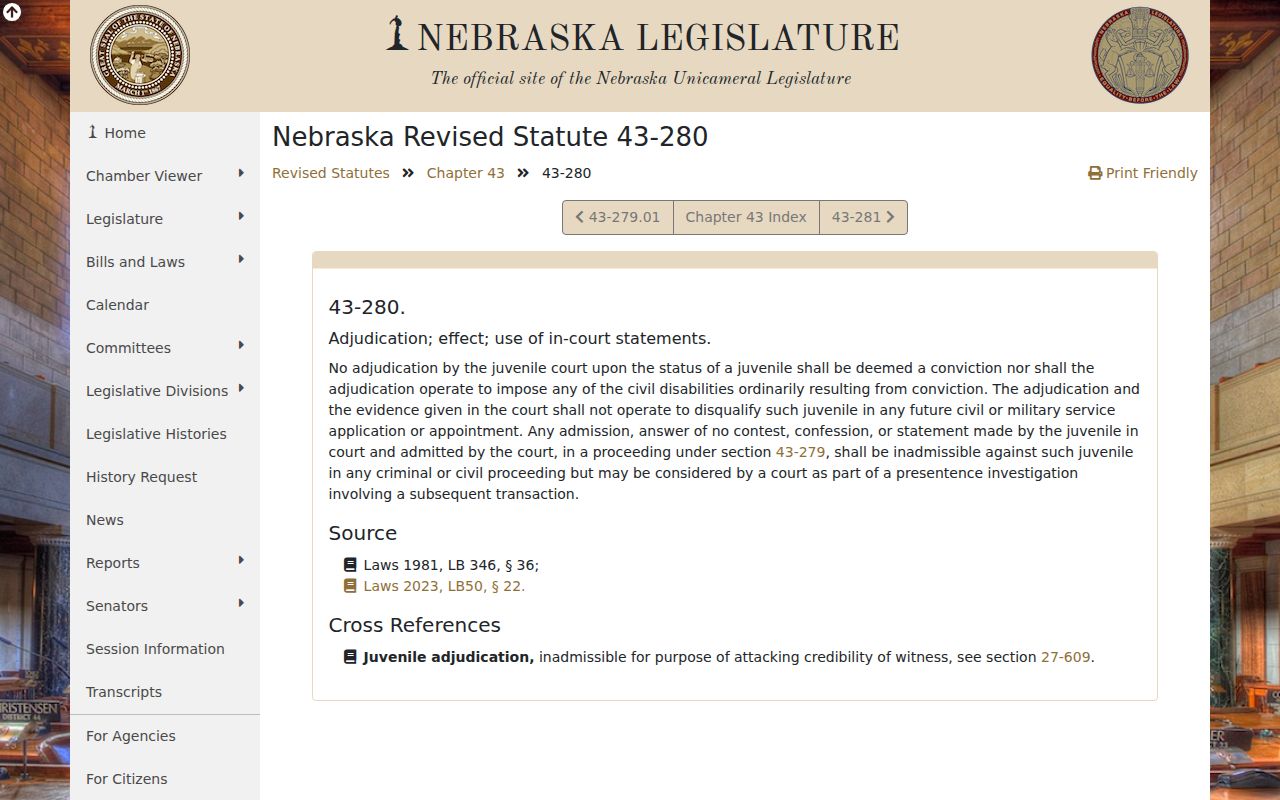
Statute keeps the analysis tied to record type. An Adams County criminal docket explanation should not leap past that to an unsupported conclusion. The adult set-aside statute lays out the separate framework for adult records.
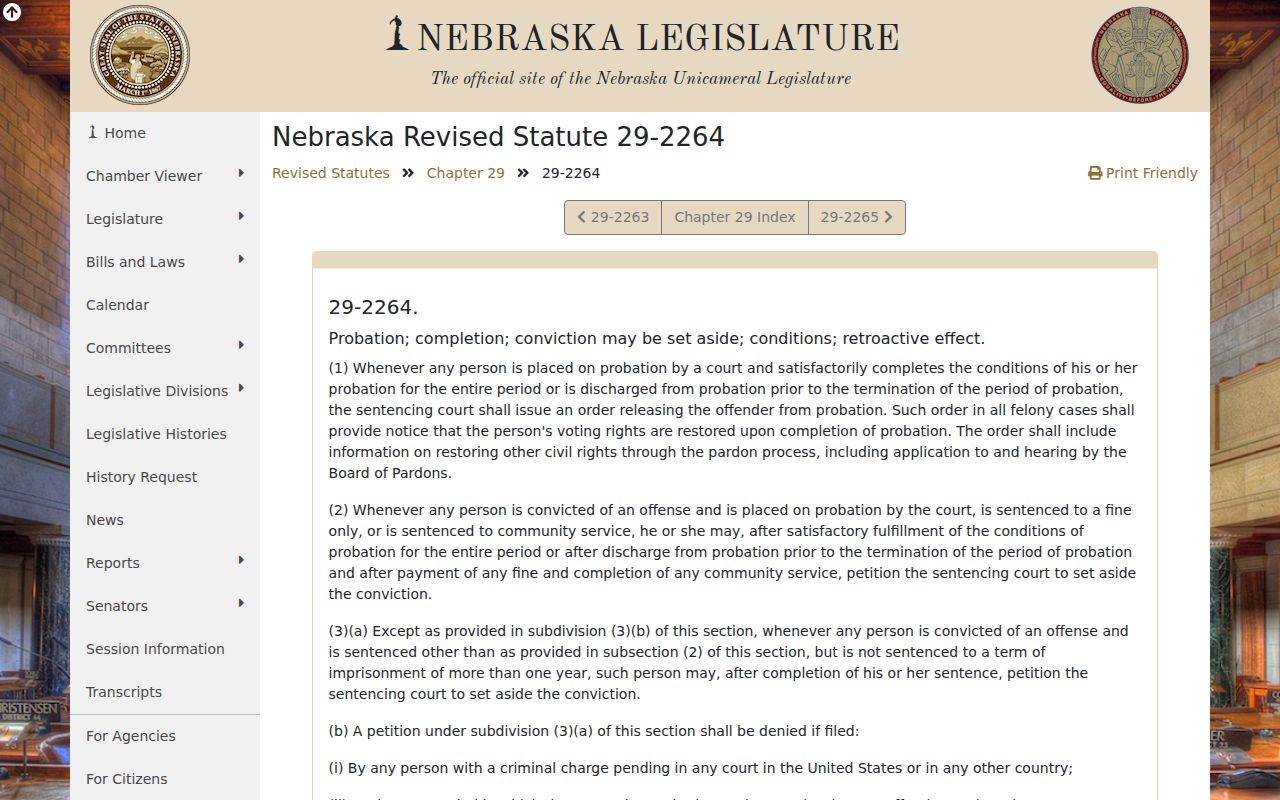
Set-asides, sealed files, restricted case images, and juvenile court records each follow their own access rules in Adams County.